
Dunnington CofE VA Primary School
Attendance
The Importance of School Attendance
School attendance is not merely a requirement but a fundamental pillar of education. It plays a pivotal role in shaping academic success, personal growth, and future prospects, making it an indispensable aspect of any educational system.
- Academic Achievement: regular attendance directly correlates with academic success. Children who attend school consistently are more likely to keep up with the curriculum, perform better in exams, and improve their life outcomes.
- Knowledge Acquisition: school is where children acquire knowledge and skills that are crucial for their personal and professional growth. Missing days means missing out on valuable learning opportunities.
- Social Development: school provides a vital social environment for children and adolescents to interact with peers, develop friendships, and learn essential social skills. Consistent attendance ensures children remain connected to their peer group.
- Building Routine: school attendance establishes a structured routine in children’s lives, teaching them time management and responsibility, which are valuable life skills.
- Teacher Interaction: regular attendance allows for meaningful teacher-child interactions. Teachers can provide personalised support, address questions, and assess individual progress more effectively when children attend regularly.
- Preventing Knowledge Gaps: frequent absences can lead to significant knowledge gaps, making it challenging for children to catch up with missed lessons, potentially resulting in long-term academic struggles.
- School Engagement: children who attend school regularly are more likely to engage in extracurricular activities, sports, and other enriching experiences that contribute to their overall development.
- Legal and Parental Responsibility: parents or guardians are legally responsible for ensuring their child's regular school attendance. Failing to do so can lead to legal consequences.
- Community Well-being: high levels of school attendance contribute to the overall well-being of communities
Our School Attendance Target
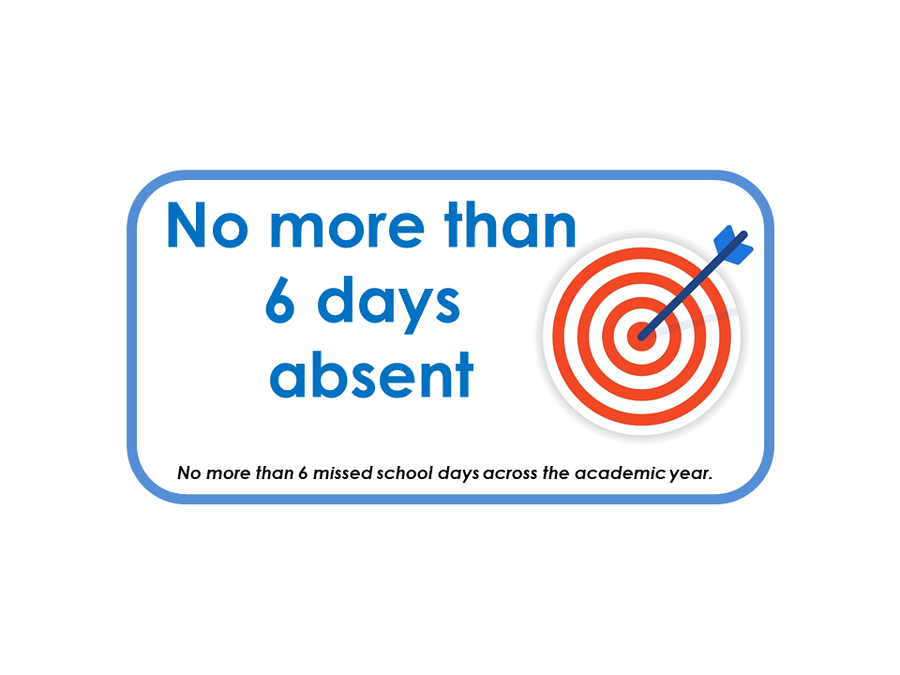
Our school's attendance target for each pupil is No More Than 6 Days Absent. This means that we want to work in partnership with families to ensure that their child is not absent from school for more than 6 days across an academic year.
We have chosen a target in days because we believe this is more meaningful to families and easier to measure than a target in percentages. The government has set a target of 95% attendance for all pupils. Our target of 6 days is in fact 97% attendance; we believe this is a realistic target for the children at our school and many children routinely achieve this target already which is fantastic.
Punctuality
School starts promptly at 8.55am. The school gates are opened at 8.45am and children can gather on the playground under the supervision of school staff until the bell rings at 8.55am. Children then line up with their teachers and they are escorted into class.
If a child arrives at school after 8.55am without prior arrangements having been agreed, he/she will be deemed late. Registers close at 9.05am and arrival at school after 9.30am, without prior approval or extenuating circumstances, will be recorded as an unauthorised absence.
Attendance Policy
Please see here our school Attendance Policy. If you have any questions or concerns about your child’s attendance record, please contact the school office and ask to talk to the Whole School Attendance Lead.
Leave of Absence During Term Time
The Supreme Court has clarified the law on unauthorised leave, including holidays, during term time (Platt v Isle of Wright 2017). The Supreme Court has made clear that attending school ‘regularly’ means that the children must attend school on every day that they are required to do so. As such, the parents of any child who is absent from school without authorisation for any length of time are likely to be considered as committing an offence under Section 444 of the Education Act 1996.
The law states a leave of absence may only be granted by a school if an application is made in advance and if it considers there are exceptional circumstances relating to the application.
Schools must judge each application individually considering the specific facts and circumstances and relevant background context behind each request.
A leave of absence is granted entirely at the school’s discretion. Generally, a need or desire for a holiday or other absence for the purpose of leisure and recreation would not constitute an exceptional circumstance.
Where a leave of absence is granted, the school will determine the number of days a pupil can be absent from school.
When making an application for Leave of Absence parents are advised to give sufficient information and time to allow the Headteacher the opportunity to consider all the exceptional circumstances and to notify parents of their decision. The school may also request further information on the application and supporting documentation where appropriate.
It is advised that if the resident parent has not received notification or a response regarding the leave of absence application, it is their responsibility to ascertain if the leave is authorised prior to the start of the leave.
The school can only consider Leave of Absence requests which are made by the ‘resident’ parent ie the parent with whom the child normally resides.
Where applications for leave of absence are made in advance and refused, the child is expected to be in school on the dates set out in the application. If the child is absent during that period, it will be recorded as an unauthorised absence. Where a leave of absence is requested, but additional days taken either prior to or after the request may be considered as part of the leave of absence.
Leave of Absences which are not made in advance cannot be authorised in line with legislation. This will result in the absence being recorded as ‘unauthorised’.
All matters of unauthorised absence relating to a Leave of Absence will be referred to the Warwickshire Attendance Service, part of Warwickshire County Council. Penalty Notices are issued in accordance with Warwickshire County Council’s Code of Conduct for Penalty Notices and in the first instance, as an alternative to prosecution proceedings.
The law relating to Penalty Notices changed with from 1 September 2024. Therefore Penalty Notices issued for Leave of Absences taken after this date will be issued in accordance with the updated legislation.
- Penalty Notices are issued to each parent of each absent child, (for example 2 children and 2 parents, making 4 invoices in total).
- First Leave of Absence offence: the Penalty Notice amount of £160 to be paid within 28 days, this is reduced to £80 each child if paid within 21 days.
- Second Leave of Absence offence within a 3 year period (from the date of issue of the first penalty notice): the amount of £160 paid within 28 days. No reduced amount,
- Payment plans will not be offered and/or payments received outside of the 28 day period will not be accepted. Where a penalty notice expires unpaid the matter will be referred to Warwickshire County Council’s Legal Services to consider criminal prosecution.
- Third Leave of Absence offence within a 3 year period (from the date of issue of the first penalty notice) A penalty notices will be not be issued and the matter will be referred to Warwickshire County Council’s Legal Services to consider instigating criminal prosecution proceedings under S444 of Education Act 1996.
Below are some examples of Leave of Absence requests which may not be authorised unless there are additional exceptional circumstances:
- Availability of cheaper holidays.
- Availability of desired accommodation.
- Poor weather experienced in school holidays.
- Overlap with beginning or end of term.
- Booked the wrong dates by mistake.
- Booked by another family member.
- Family birthdays.
- Unable to take a holiday in school holidays due to work commitments.
- Adult appointments affecting bringing a child to school or collecting on time.
- Different term dates for children at schools in another local authority.

Persistent Absence
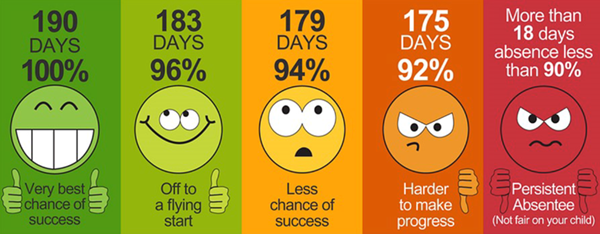
At Dunnington School, we monitor a pupil's attendance by looking at the number of days that they have been absent during a school year. If a pupils has been absent for more than 18 days in a school year, the pupil is categorised as being 'persistently absent.' This could lead to intervention from Warwickshire Attendance Service. Good attendance is vital for the success of pupils and their well being.
There are 190 days in a school year, which leaves the remaining 175 days in the year to spend on family time, shopping, appointments, holidays and other things.
|
How many days will make your child a persistent absentee? |
|
|
Half Term 1 |
3½ days off school from September until October half term holiday will make your child PA. |
|
Half Term 1-2 |
7 days off school from September until the Christmas holiday will make your child PA. |
|
Half Term 1-3 |
10 days of absence from September until February half term will make your child PA. |
|
Half Term 1-4 |
12½ days of absence from September until the Easter holidays will make your child PA. |
|
Half Term 1-5 |
15½ days of absence from September until May half term will make your child PA. |
|
Half Term 1-6 |
19 days of absence for the full academic year will make your child PA. |
Warwickshire Attendance Service
Dunnington C of E Primary School is responsible for liaising closely with the Local Authority’s Attendance Service and will follow their standard approaches in managing attendance issues.
Where all voluntary support options have not been successful, or have not been engaged with, the law protects pupils’ right to an education and provides a range of legal interventions to formalise attendance improvement efforts. Warwickshire Attendance Service can use the following legal interventions/formalised support: Attendance Contracts, Notice to Improve, Issue of Penalty Notices, Education Supervision Orders, Attendance Prosecution and consideration of application of Parenting Orders.
After considering the individual circumstances of a family, Warwickshire Attendance Service will decide which intervention will be most appropriate. Voluntary support options are not appropriate for an unauthorised Leave of Absence in term time.
Prosecutions for non-school attendance must be conducted in line with the Warwickshire County Council Non-school Attendance and Penalty Notice Code of Conduct and the Code for Crown Prosecutors. They must pass the evidential and public interest tests.
Your child’s progress academically as well as socially is our shared priority. Every lesson counts!
EBNSA (Emotionally Based No-School Attendance)
Emotional Based School Non-Attendance (EBSNA) is a broad umbrella term used to describe a group of children and young people who have severe difficulty in attending school due to emotional factors, often resulting in prolonged absences from school. The impact of EBSNA on young people and schools is far reaching. Outcomes for young people who display EBSNA include poor academic attainment, reduced social opportunities and limited employment opportunities. EBSNA is also associated with poor adult mental health.
We know that the earlier difficulties are identified and support put in place the more successful we are at developing children and young people’s ability to cope with their anxiety and develop their resilience to cope with life's challenges resulting in improved attendance and ongoing life opportunities.
There is no single cause for EBSNA and there are likely to be various contributing factors for why a young person may be finding it difficult to attend school. It is well recognised in the research literature that EBSNA is often underpinned by several complex and interlinked factors, including the young person, the family and the school environment (Thambirajah et al, 2008).
However Kearney and Silberman’s (1990) review of the literature indicates that there tends to be four main reasons for school avoidance:
- To avoid uncomfortable feelings brought on by attending school, such as feelings of anxiety or low mood.
- To avoid situations that might be stressful, such as academic demands, social pressures and/or aspects of the school environment.
- To reduce separation anxiety or to gain attention from significant others, such as parents or other family members.
- To pursue tangible reinforces outside of school, such as going shopping or playing computer games during school time.
At Dunnington CofE Primary School, we are here to work collaboratively with parents/carers, and professionals, to support those children who show signs, or are suffering, from EBSNA. It is vital that we act quickly to the early signs of school based anxiety and respond sensitively to any concerns. We look to parents/carers to inform us as soon as they possibly can about any signs of reluctance.
These signs could include:
- Children openly talking about not wanting to attend school
- Frequent tummy or head aches
- Children finding it increasingly more difficult to leave parents/carers to enter school
- An increase in sensitivity when conversations about school take place
- Reduction in social ability, maybe becoming isolated
- Spending time away/avoiding things that would previously not cause any distress
- Seeking more connection with familiar adults; this could also be displayed as 'fussy' behaviour
- Angry outbursts when the demand to attend school is made
Useful Links and Documents